Cobblestones to Coffee Bars: How Prague's Coffeehouse Architecture Is Quietly Redesigning America's Third Spaces
Walk into a certain kind of specialty coffee shop in cities like Portland, Nashville, or Brooklyn these days, and something might feel a little... different. There's a warmth to it that's hard to pin down. Maybe it's the low, amber lighting. Maybe it's the way the seating seems deliberately broken up — a velvet banquette here, a pair of high-backed wooden chairs tucked behind a half-wall there. Maybe it's the sense that the room wasn't designed to move you through quickly, but to hold you.
What you're noticing might have more to do with Prague than you'd ever expect.
The Czech capital has been home to a distinct coffeehouse culture — known locally as kavárna — for centuries. These weren't just places to grab a quick caffeine fix. They were intellectual gathering rooms, artistic retreats, and neighborhood living rooms all rolled into one. And the physical spaces themselves reflected that purpose in deeply intentional ways. Now, a growing number of American café owners and hospitality designers are looking to that tradition for inspiration — and the results are reshaping what we think a coffee shop can actually be.
What Made Prague's Coffeehouses So Distinctive
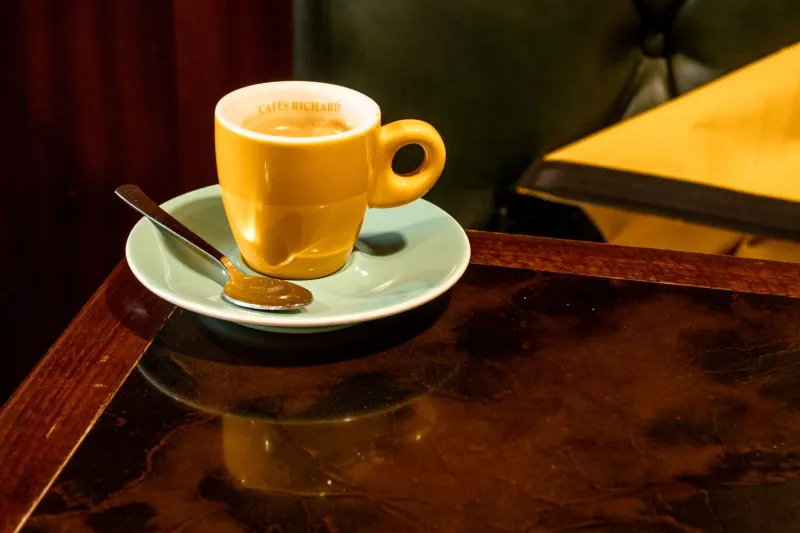
To understand the influence, it helps to picture a classic Prague kavárna. Think heavy drapes that muffle street noise. Dark, richly grained wood that's been polished by decades of use. Tiled floors in geometric patterns that feel both grand and intimate. Marble tabletops just large enough for a coffee, a newspaper, and a notebook. High ceilings that create a sense of occasion without feeling cold.
But it wasn't just aesthetics. The layouts of these spaces were deliberately layered — main rooms that felt communal, side alcoves that offered privacy, mezzanines that let you observe without being observed. The famous Café Slavia on the banks of the Vltava River, or the Art Nouveau grandeur of the Café Imperial, weren't designed to maximize table turnover. They were designed to make you want to stay.
This is the core idea that's resonating with American café owners right now: the idea that a coffee shop can function as a genuine third place — not home, not work, but a space that belongs to you in a different, almost civic way.
American Cafés Taking Notes
In Chicago, a specialty café called Brno opened a few years back with an interior that its founders openly describe as kavárna-inspired. The space features reclaimed oak millwork, deep-set window benches, and a back room with clustered seating that deliberately creates the feel of semi-private conversation nooks. The owners spent time visiting coffeehouses in Prague and Brno (the Czech Republic's second city) before finalizing their design.
"We kept asking ourselves why those spaces made us feel so comfortable, so settled," one of the founders explained in a design trade interview. "It came down to the layering. There was always somewhere to go deeper into the room. You weren't just sitting in an open floor plan waiting for someone to need your table."
That layering principle is showing up in other cities too. A café in Austin recently redesigned its interior after the owners visited Central Europe and were struck by how Prague's coffeehouses used architectural transitions — a step up, a change in ceiling height, a shift in lighting temperature — to create distinct zones within a single room. Their redesigned space now features three distinct "rooms" within one open footprint, each with a slightly different feel and function.
In New York, a specialty roaster in the West Village leaned into the ornamental side of the tradition, commissioning hand-painted ceiling details and sourcing antique brass fixtures to evoke the decorative richness of Prague's early 20th-century café interiors. The result is a space that feels genuinely unlike anything else in the neighborhood — and that's very much the point.
The Function Behind the Form
What's interesting is that these aren't just aesthetic choices. The design philosophy behind Prague's historic coffeehouses was always tied to a specific kind of social function — and that function is exactly what a lot of Americans are hungry for right now.
The concept of the third place, popularized by sociologist Ray Oldenburg, describes spaces outside home and work where community actually forms. For a long time in the US, coffee shops sort of filled that role — but the rise of laptop culture, fast-casual formats, and grab-and-go service models gradually hollowed it out. Many American coffee shops started feeling more like co-working spaces with espresso machines than actual gathering places.
Prague's kavárna tradition offers a counter-model. These were places where people lingered not because they had nowhere else to be, but because the space itself invited it. The architecture made slowness feel natural. And that's what a certain segment of American coffee culture is actively trying to rebuild.
Small Details, Big Impact
You don't have to gut-renovate a space to bring some of this philosophy in. A lot of the Czech coffeehouse effect comes from surprisingly accessible choices.
Lighting is probably the biggest lever. Prague's historic cafés relied heavily on warm, localized light sources — table lamps, wall sconces, pendant fixtures positioned low over seating areas — rather than overhead illumination. This creates an instinctive sense of comfort and privacy that's hard to achieve with recessed ceiling lights, no matter how tastefully dimmed.
Furniture variety matters too. The mix of seating types — upholstered chairs, wooden café chairs, banquettes, bar stools — means different people can find their ideal spot. It also breaks up visual monotony in a way that feels lived-in rather than designed.
And then there's the small stuff: coat hooks near seating, actual ceramic cups instead of paper, a menu that doesn't feel like it's in a hurry. These details add up to a message the space sends to customers — you're welcome to stay.
Why This Matters Beyond Design
At Café Fin v Praze, we've always believed that great coffee is only part of the story. The experience of drinking it — where you are, how you feel, who you're with — shapes the cup just as much as the roast or the brew method.
Prague's coffeehouse tradition understood this intuitively. The architecture wasn't decorative. It was functional in the deepest sense: it created the conditions for connection, contemplation, and genuine rest. The fact that American café owners are rediscovering this isn't just a design trend. It's a cultural recalibration — a recognition that we want our coffee spaces to do more than serve coffee.
So next time you settle into a corner booth at your favorite local spot and think, I could stay here all afternoon — there's a good chance a little bit of Prague had something to do with that.